There are six passages in the Bible that refer to forms of same-sex behavior: three in the Old Testament and three in the New Testament. We'll study them in the order that they appear in Scripture, starting with the story of Sodom and Gomorrah in Genesis 19.
Sodom and Gomorrah are first mentioned in Genesis 10:19 among the cities where the descendants of Canaan scattered. We hear about them again in Genesis 13. There, Abraham — then called Abram — and his nephew Lot decide to part ways in order to avoid disputes over the land, and Lot moves near Sodom. Genesis 13:13 tells us, "Now the people of Sodom were wicked and were sinning greatly against the Lord," but it doesn't offer any details about the nature of their sinfulness.
Five chapters later, in Genesis 18, God and two angels appear to Abraham and Sarah in the form of men. Abraham and Sarah show them lavish hospitality. Abraham bows low to the ground when he sees them, he asks Sarah to make them bread from the finest flour, and he selects a choice, tender calf for them to eat. As God and the angels are about to leave, God asks in verse 17, "Shall I hide from Abraham what I am about to do?" Then in verses 20 and 21, he says:
"The outcry against Sodom and Gomorrah is so great and their sin so grievous that I will go down and see if what they have done is as bad as the outcry that has reached me. If not, I will know."
Abraham then bargains with God, asking God at first not to destroy the city if he finds fifty righteous people there. Ultimately, God agrees not to destroy the city if he finds even ten righteous people there. But as the next chapter makes clear, even that is too high a number, because virtually everyone in Sodom is wicked.
The Threatened Violence Against the Angel Visitors 2:02
At the start of Genesis 19, the two angels arrive in Sodom, and Lot greets them with the same kind of respect and hospitality that Abraham had shown them. He calls them "my lords," refers to himself as their servant, and insists that they stay at his house for the night. He then bakes bread and prepares a meal for them.
But Lot's kindness was quickly shown not to be representative of the rest of the city. In verses 4 and 5, we read, "Before they had gone to bed, all the men from every part of the city of Sodom — both young and old — surrounded the house. They called to Lot, 'Where are the men who came to you tonight? Bring them out to us so that we can have sex with them.'" In response, Lot tells the men in verses 6 and 7:
"No, my friends. Don't do this wicked thing. Look, I have two daughters who have never slept with a man. Let me bring them out to you, and you can do what you like with them. But don't do anything to these men, for they have come under the protection of my roof."
The men respond angrily, saying in verse 9, "Get out of our way… This fellow came here as a foreigner, and now he wants to play the judge! We'll treat you worse than them."
The men then try to break down the door, but the angels strike them with blindness and thwart their attack. Lot and his family then flee the city, and God destroys Sodom and Gomorrah with fire and brimstone.
Many Christians have heard or learned at some point in their lives that the sin that caused God to destroy Sodom and Gomorrah was same-sex behavior. And it's true that, in Genesis 19:5, the men of Sodom demand that Lot bring out his guests so that they can have sex with them. Although the men were actually angels, this would at least ostensibly have been a same-sex act, and it certainly is presented very negatively. But some basic aspects of this passage call into question its relevance for discussions about any kind of consensual same-sex relationships.
First, the men are not expressing romantic interest in Lot's guests. They are threatening to gang rape them.
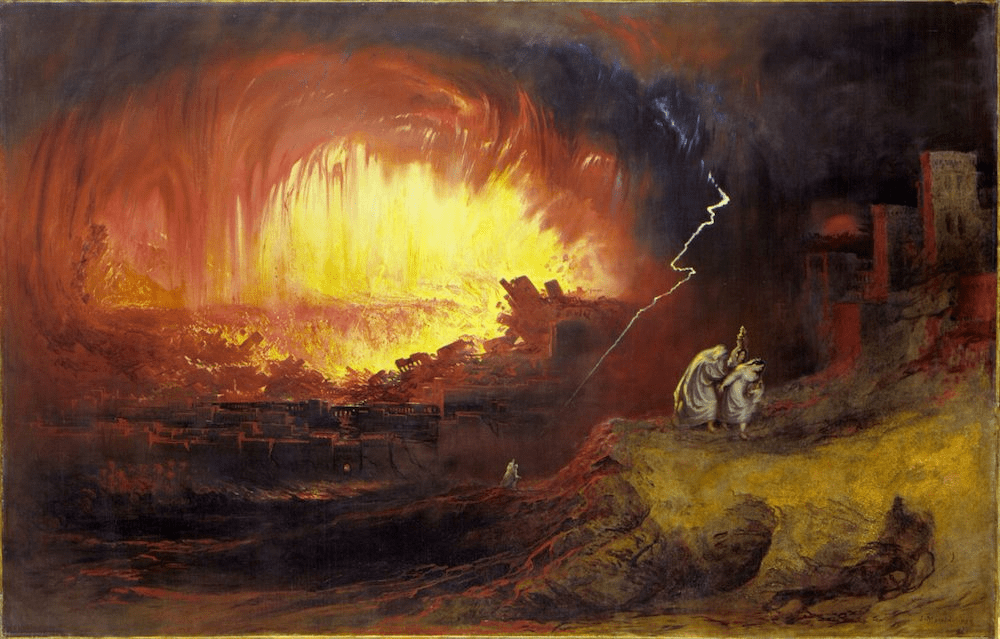
The Destruction of Sodom and Gomorrah — John Martin
The only form of same-sex behavior described in Genesis 19 is a threatened gang rape.
We've seen in previous modules that it was sadly common for men to rape other men as a tactic of aggression, domination, and humiliation in the ancient world. The men of Sodom make their violent intentions clear in verse 9 when they tell Lot, "We'll treat you worse than them." If they were merely seeking to have consensual sex with Lot's guests, then this statement wouldn't make sense. Saying "we'll treat you worse than them" makes clear that they intended to harm Lot's guests.
The Parallel Story in Judges 19 4:49
The violent nature of the men of Sodom's plans is made even clearer in a strikingly similar — and even more disturbing — story recounted in Judges 19. In that passage, a Levite is traveling with his concubine. On their travels, they stop in the town of Gibeah, and an old man who had moved to Gibeah invited the Levite and his concubine to spend the night with him rather than stay in the city square. The old man showed them great hospitality, feeding their donkeys and giving them food and drink.
But in Judges 19, just as in Genesis 19, the story takes a sharp turn for the worse.
"While they were enjoying themselves, some of the wicked men of the city surrounded the house. Pounding on the door, they shouted to the old man who owned the house, 'Bring out the man who came to your house so we can have sex with him.'"
Judges 19:22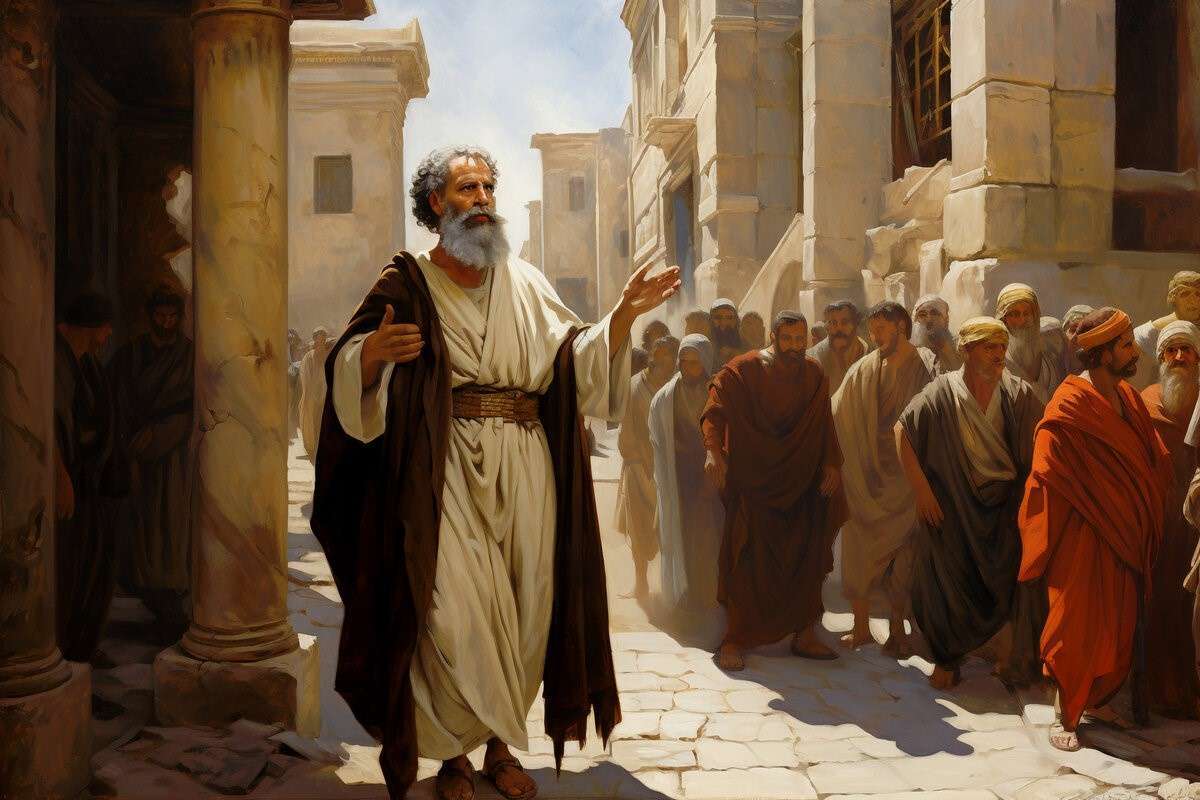
The old man then responds just as Lot did, saying in verses 23 and 24, "No, my friends, don't be so vile. Since this man is my guest, don't do this outrageous thing. Look, here is my virgin daughter, and his concubine. I will bring them out to you now, and you can use them and do to them whatever you wish. But as for this man, don't do such an outrageous thing."
Unfortunately, with no angels present this time to stop the attack, the men in Gibeah are able to carry out their plans. Verse 25 horrifyingly tells us that "the man took his concubine and sent her outside to them, and they raped her and abused her throughout the night, and at dawn they let her go." But she didn't survive the brutal sexual violence. As the next verses explain, in the morning, the Levite found her lying dead in the doorway.
This is among the most horrific stories in the Old Testament, and it's impossible to read it without feeling sick to your stomach. But as gruesome and disturbing as it is, it provides us with a clear picture of what the men of Sodom had in mind when they said they wanted to "have sex" with Lot's guests. The men of Gibeah make the exact same demand, telling the old man to bring out his guest so they could "have sex with him." But it's clear that their intention was not consensual sex, but rape and possibly murder, as that's exactly what they did to the Levite's concubine.
In the next chapter, the Levite explains that the men's intention had been murder. He says in Judges 20:4–5:
"I and my concubine came to Gibeah in Benjamin to spend the night. During the night the men of Gibeah came after me and surrounded the house, intending to kill me. They raped my concubine, and she died."
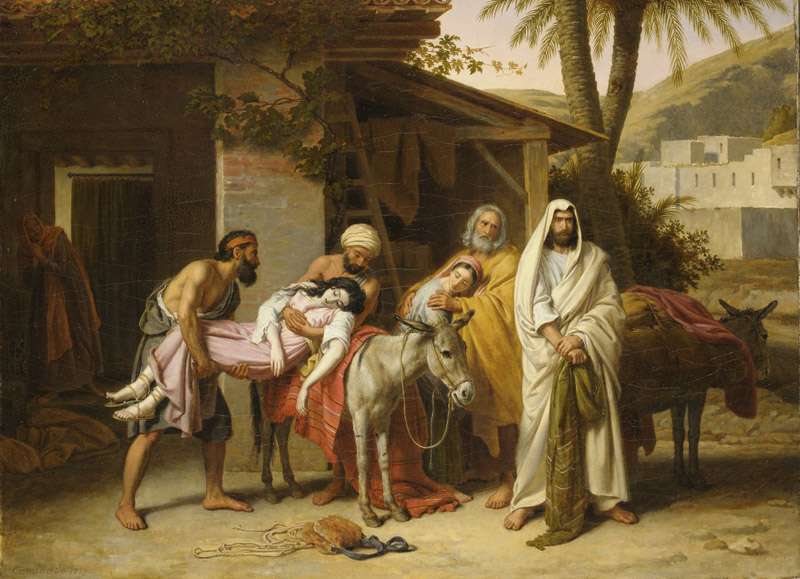
The Levite of Ephraim — A.F. Caminade, 1837
Gang rape and murder. That's what the men of Sodom threatened to do, and it's what the men of Gibeah both threatened and carried out. This is indeed evil, but it has nothing to do with same-sex relationships that are consensual, much less those that are marked by long-term commitment, faithfulness, and love.
The Role of Gender in These Accounts 7:54
Still, some say, wasn't the same-sex aspect of both threatened rapes still relevant to the stories? After all, in both cases, the owners of the homes offered women instead of men to the mobs, which could be a sign that same-sex behavior was understood to be worse than opposite-sex behavior. I do think that gender is relevant to these stories, but not in a way that maps onto our modern gay/straight dichotomy.
In ancient times, it certainly was seen as more degrading for a man to be raped than for a woman to be raped. But that wasn't because of beliefs about anatomical or procreative gender complementarity. It was because, in a deeply patriarchal world, women were seen as inferior to men in their very value, dignity, and honor as people. Men had more honor to lose, so violating them was seen as a worse offense. Those patriarchal norms are the backdrop for Lot's offer of his virgin daughters to the mob and for the old man in Gibeah's offering up his own virgin daughter and the Levite's concubine: women were thought to be less important than men.
Another, related factor in these stories was the supreme importance of hospitality in the ancient world. Inns were rare, so travelers would frequently have to sleep out in the open — vulnerable to thieves and worse — if no one showed them hospitality and invited them into their home. Both Genesis 19 and Judges 19 start with stories of great hospitality, but in both cases, the hospitable man is a foreigner who is living in the town, not a native. The foreigner's hospitable actions are presented in sharp contrast to the wickedness of the people of the city themselves, and in both cases, the foreigners appeal to the duty of hospitality to try to dissuade the attackers.
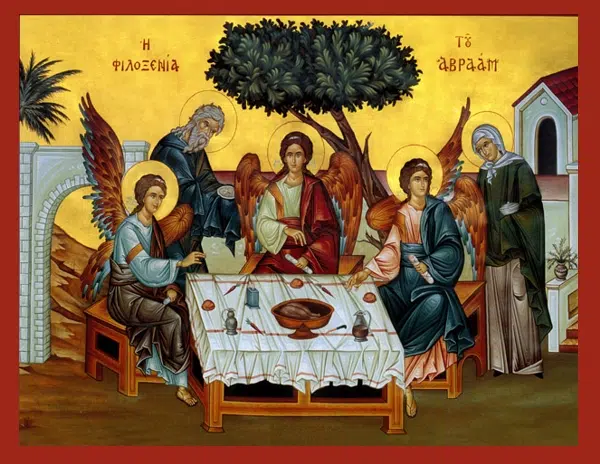
The Hospitality of Abraham
In Genesis 19:8, Lot says, "But don't do anything to these men, for they have come under the protection of my roof." Likewise, in Judges 19:23, the old man says, "Since this man is my guest, don't do this outrageous thing." But as we see, the duty of hospitality only extends to the male guest, as the old man in Gibeah freely offers his guest's female concubine to the mob. So to the extent that gender is relevant to these stories, it's not relevant in a way that anyone today would want to argue reflects the will of God.
The Old Testament References to Sodom and Gomorrah 10:26
Moreover, as appalling as threatened gang rape is, it's worth remembering that God was already planning to destroy Sodom before Genesis 19. The men of Sodom's wickedness when the angels arrived — all of the men, both young and old — merely confirmed that there were not even ten righteous people in the city. But subsequent references to the cities in Scripture focus on other issues.
No references to Sodom and Gomorrah in Scripture connect the sin of Sodom to same-sex behavior specifically.
There are thirteen references to Sodom and Gomorrah in the Old Testament after Genesis 19.1 Most often, the cities are invoked as a symbol of general evil and as a warning of the destruction God will bring on sinful people and nations, as in Deuteronomy 29:23 and 32:32. When Sodom's evil is specified, the focus is generally on injustice, oppression, and idolatry. Isaiah denounced Judah as a "sinful nation," comparing it to the "rulers of Sodom" and the "people of Gomorrah" in Isaiah 1:10. But in verses 21–23 of the same chapter, Isaiah makes clear the type of sin he has in mind. Judah, he says:
"[O]nce was full of justice; righteousness used to dwell in her — but now murderers! Your silver has become dross, your choice wine is diluted with water. Your rulers are rebels, partners with thieves; they all love bribes and chase after gifts. They do not defend the cause of the fatherless; the widow's case does not come before them."
Jeremiah 23:14 quotes God as saying that the prophets of Jerusalem "are all like Sodom to me" and "the people of Jerusalem are like Gomorrah." But the sins Jeremiah highlights are adultery, idolatry, and power abuses. Verse 10 says, "The land is full of adulterers…The prophets follow an evil course and use their power unjustly." Verse 13 adds that the prophets of Samaria "prophesied by Baal and led my people Israel astray."
Amos 4:1–11 and Zephaniah 2:8–11 invoke Sodom to warn of God's judgment on those who "oppress the poor" or who pridefully insult and mock God's people.
The most detailed description of the sins of Sodom in Scripture appears in Ezekiel 16:49–50. There, Ezekiel quotes God as saying:
"Now this was the sin of your sister Sodom: She and her daughters were arrogant, overfed and unconcerned; they did not help the poor and needy. They were haughty and did detestable things before me. Therefore I did away with them as you have seen."
Ezekiel 16:49–50The Bible explicitly declares the sin of Sodom to be arrogance, pride, and failure to help the poor and needy — not same-sex relationships.

Ezekiel — Renaissance fresco
Still, some have argued that the reference to "detestable things" in verse 50 could refer to same-sex behavior based on the fact that male same-sex intercourse was called "detestable" — or an "abomination," depending on the translation — in the book of Leviticus.
But the Hebrew word for "detestable" — toevah — is used 117 times in the Old Testament, and only five of those uses refer to or encompass the prohibitions of male same-sex intercourse in Leviticus 18 and 20. The term toevah appears forty other times in Ezekiel alone, mostly to describe idolatrous practices. In Ezekiel 16 specifically, toevah is used seven other times to describe idolatry and adultery, not same-sex behavior. So it's unlikely that the term in verse 50 was used to refer to same-sex behavior specifically. And even if it had been, the only type of same-sex behavior described in Genesis 19 is a threatened gang rape, so that would still be fundamentally different from what we're talking about today.
References to Sodom in Other Ancient Jewish Literature 14:46
Other Jewish literature written between the time of the Old and the New Testaments describes the sin of Sodom as arrogance and inhospitality. Sirach 16:8 says that God "did not spare the neighbors of Lot, whom he loathed on account of their arrogance," and 3 Maccabees 2:5 likewise says that the people of Sodom "acted arrogantly." Wisdom 19:15 focuses on the issue of inhospitality, condemning Sodom "for having received strangers with hostility."
Only two Jewish texts written before the time of Christ explicitly describe Sodom as sexually immoral. But even those 2nd-century BC texts — the Testaments of the Twelve Patriarchs and Jubilees — focus on sexual sins in general, not same-sex behavior in particular. In fact, the Testaments of the Twelve Patriarchs compares the vices of Sodom to heterosexual sins. The Testament of Benjamin 9:1–2 reads, "I will tell you that you will be sexually promiscuous like the promiscuity of the Sodomites and will perish, with few exceptions. You shall resume your actions with loose women, and the kingdom of the Lord will not be among you."
Another passage in the Testaments of the Twelve Patriarchs, found in the Testament of Naphtali 3, says that Sodom "departed from the order of nature." Some modern readers are inclined to interpret this phrase as a reference to same-sex relations, but the very next line continues, "Likewise the Watchers departed from nature's order."
The Watchers is a reference to the story of the Nephilim of Genesis 6:4. That verse says, "The Nephilim were on the earth in those days — and also afterward — when the sons of God went to the daughters of humans and had children by them."
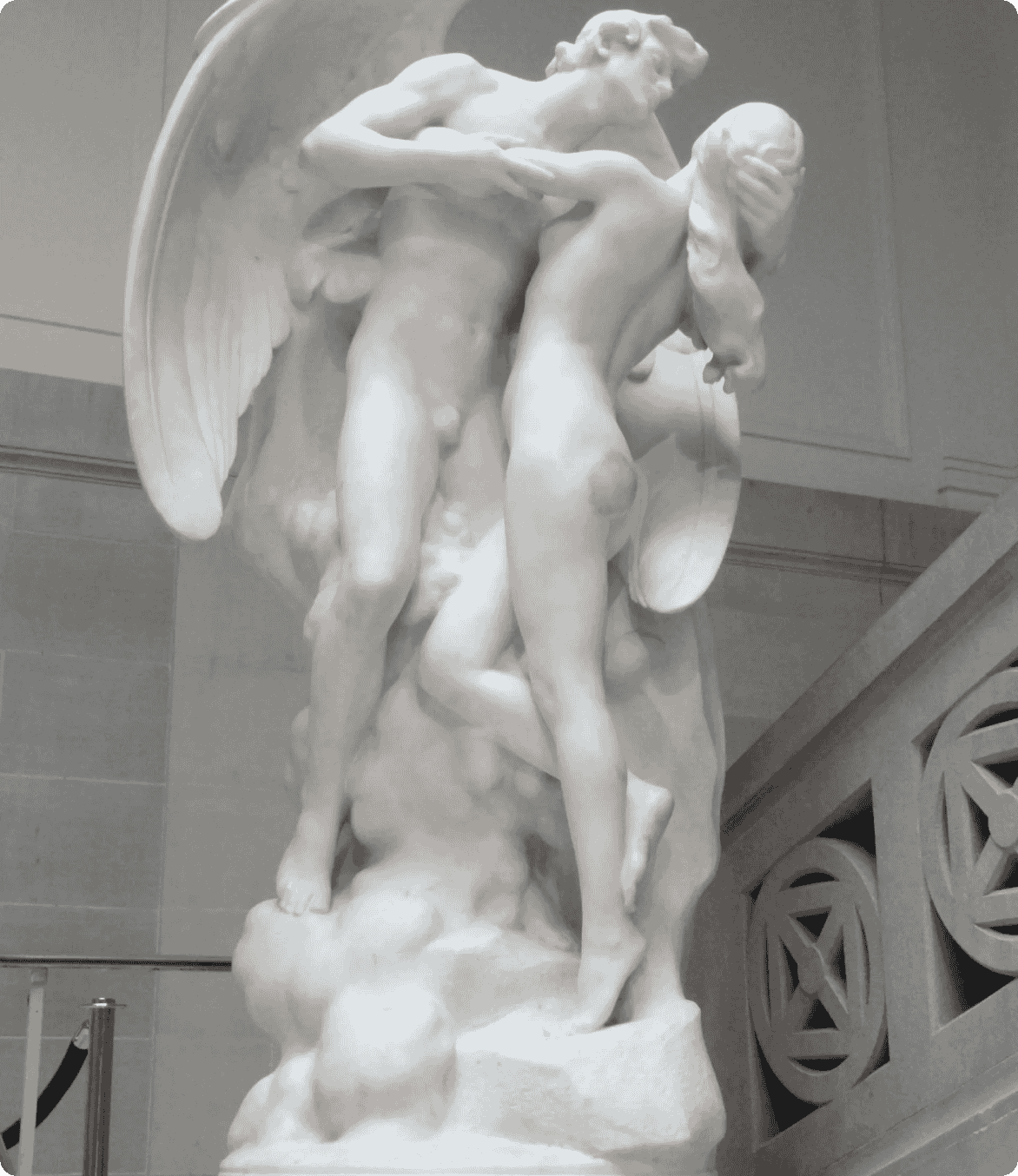
The Sons of God Saw the Daughters of Men That They Were Fair — Daniel Chester French
The sons of God here have historically been understood as angels, and their sexual unions with women were seen as departing from the order of nature because they violated the natural boundary between angels and humans. Consequently, Michael Carden explains in his book Sodomy that the description of Sodom as departing from the order of nature in the Testament of Naphtali also refers to "crossing the boundaries of the human and the angelic," as the guests whom the men of Sodom attempted to rape were angels.2
New Testament Texts on Sodom and Gomorrah 17:14
When we come to the New Testament, Sodom and Gomorrah are mentioned eight times, again primarily in the context of general evil and inhospitable treatment of strangers. In both Matthew and Luke, Jesus invokes Sodom when describing the judgment that towns will face if they do not welcome his disciples. In Matthew 10:14–15, Jesus says, "If anyone will not welcome you or listen to your words, leave that home or town and shake the dust off your feet. Truly I tell you, it will be more bearable for Sodom and Gomorrah on the day of judgment than for that town."
Jesus makes a similar statement in Luke 10:10–12, and in Matthew 11:23–24, he refers to Sodom as a symbol of unrepentance.3 Only two texts in the New Testament describe Sodom as sexually immoral, but neither one refers to same-sex relations specifically. 2 Peter 2:7 says that Lot was "distressed by the depraved conduct of the lawless." The Greek term translated as "depraved," aselgeia, carries the connotation of licentiousness, but it is a general term, not a specific reference to same-sex behavior.4
Jude echoes the Testament of Naphtali by comparing the sexual transgressions of the people of Sodom to the angels who mated with human women in Genesis 6. Verses 6 and 7 of Jude say this:
"And angels who did not keep their own domain, but abandoned their proper abode, He has kept in eternal bonds under darkness for the judgment of the great day, just as Sodom and Gomorrah and the cities around them, since they in the same way as these indulged in gross immorality and went after strange flesh, are exhibited as an example in undergoing the punishment of eternal fire."
The phrase "strange flesh" in Jude 7 is sometimes translated in modern Bibles as "perversion" or "unnatural desire," so some read it as a reference to same-sex behavior specifically. But the Greek phrase that is used here is sarkos heteras, which literally means "other" or different flesh. Heteras, of course, is the prefix for heterosexuality, not homosexuality. To be clear, heterosexuality was not the sin of Sodom either, but Jude 7 indicts the men of Sodom for pursuing flesh that was too different from their own, not too similar.5
As with the Testament of Naphtali, the sexual transgression in view here is most likely the fact that the men of Sodom attempted to rape angels — strange, or other, flesh. That interpretation is supported by the reference in Jude 6 to the Nephilim from Genesis 6. Jude 7 says that Sodom behaved "in the same way" as the Nephilim, the most straightforward reading of which is that they violated the same angel/human boundary.6 Biblical scholar Richard Hays agrees, writing, "The phrase 'went after other flesh' refers to their pursuit of nonhuman (i.e., angelic!) 'flesh.' The expression sarkos heteras means 'flesh of another kind;' thus, it is impossible to construe this passage as a condemnation of homosexual desire, which entails precisely the pursuit of flesh of the same kind."7
When Did the Same-Sex Reading of the Sodom Story Develop? 20:34
So if the Bible itself doesn't support the idea that God destroyed Sodom and Gomorrah for engaging in same-sex behavior, then where did this interpretation come from, and how has it been so influential throughout most of Christian history? The first writer who interpreted Sodom's destruction as punishment for same-sex behavior was the Hellenistic Jewish philosopher Philo of Alexandria. He wrote in the first century, so it's worth noting that his interpretation of Genesis, which has traditionally been dated to 1400 BC, was not an early one.
But even though Philo argued that same-sex behavior was the sin of Sodom, his description of same-sex behavior sounds very different from how we think of it today. He wrote that same-sex behavior was motivated by an insatiable appetite caused by too much material wealth:
"The land of the Sodomites…was brimful of innumerable iniquities, particularly such as arise from gluttony and lewdness, and multiplied and enlarged every other possible pleasure with so formidable a menace that it had at last been condemned by the Judge of All. The inhabitants owed this extreme license to the never-failing lavishness of their sources of wealth, for, deep-soiled and well-watered as it was, the land had every year a prolific harvest of all manner of fruits, and the chief beginning of evils, as one has aptly said, is goods in excess."
Philo of Alexandria, On Abraham8"Goods in excess," Philo explained, led to excessive appetites across the board — from drinking to food to sex:
"Incapable of bearing such satiety, plunging like cattle, they threw off from their necks the law of nature and applied themselves to deep drinking of strong liquor and dainty feeding and forbidden forms of intercourse. Not only in their mad lust for women did they violate the marriages of their neighbours, but also men mounted males without respect for the sex nature which the active partner shares with the passive; and so when they tried to beget children they were discovered to be incapable of any but a sterile seed."
Ibid.9
Philo of Alexandria
For Philo, same-sex behavior wasn't an expression of a sexual orientation. It was an expression of out-of-control lust. And the men he describes who engaged in same-sex behavior also slept with married women, and after their same-sex exploits, they went back to having sex with women, only to find that they could no longer have children.
Philo's view of same-sex relations fits with the widespread ancient understanding that same-sex behavior was a product of excessive pleasure-seeking, not an expression of an exclusive sexual orientation. In that sense, it was no different than gluttony or drunkenness, as it was something that anyone might do if they lost self-control and overindulged their appetites.
Philo's reading of the Sodom story would eventually become the dominant interpretation among Christians, but not until the early fifth century. In the third century, Origen wrote that the sin of Sodom was turning away strangers:
"Hear these words, you who close your houses to strangers; hear these words, you who avoid a guest as an enemy…. [Lot] escapes the conflagration for this reason alone: because he opened his house to strangers. Angels entered the hospitable house; fire entered the houses closed to strangers."
Origen10
Origen
In the fourth century, Jerome focused on pride and gluttony as the central vices of Sodom, writing, "The Sodomitic sin is pride, bloatedness, the abundance of all things, leisure and delicacies."11 Other Christian interpreters in the fourth century focused on gluttony as well and wrote that Sodom's gluttony led to sexual immorality. As the monk John Cassian explained, "through fulness of bread they were inflamed with uncontrollable lust of the flesh."12
Increasingly, by the early fifth century, the focus shifted from gluttony, pride, and inhospitality to same-sex behavior specifically. The Roman theologian Paulus Orosius explained that Sodom's same-sex behavior was a direct result of its material excess, writing that "out of luxury grew such disgraceful passions that men rushed upon men committing base acts."13 Orosius' teacher, Augustine, made the same point even more forcefully, arguing that "males burning toward males with hideous lust" was the primary sin of Sodom.14
The idea that Sodom was destroyed for same-sex behavior didn't become the consensus Christian view until the fifth century — and even then, same-sex behavior was understood as lustful excess, not loving orientation.
From the fifth century through the twentieth century, the sin of Sodom was consistently identified by Christians as same-sex behavior, eventually giving rise to the term "sodomy." This term was first coined in Latin in the mid-eleventh century by a monk named Peter Damian, and it continued to be widely used until recent generations to describe both same-sex relations and other forms of non-procreative sex.15

Peter Damian
A Parallel in Biblical Interpretation: The Sin of Onan 26:01
Today, Genesis 19 is no longer central to the debate about same-sex relationships, as even many non-affirming Christians and scholars now acknowledge that same-sex behavior was not the sin of Sodom and that this story has long been misinterpreted. We can only know so much about why this misinterpretation developed, but this wasn't the only text in Scripture that was misinterpreted to condemn a wide range of behavior.
In Genesis 38, Onan is instructed by his father to do his levirate duty and raise up offspring for his dead brother by sleeping with his brother's widow. But verses 9 and 10 explain:
"But Onan knew that the child would not be his; so whenever he slept with his brother's wife, he spilled his semen on the ground to keep from providing offspring for his brother. What he did was wicked in the LORD's sight; so the LORD put him to death also."

Onan
Genesis 38 is explicit about what Onan did wrong: he refused to provide offspring for his brother because he knew that the child would not be his. He selfishly avoided carrying out his family obligations. But despite the clarity of the biblical text, Christians eventually began to interpret this story as a condemnation of masturbation, of "spilling one's seed" generally. "Onanism" even became a euphemism for masturbation, which was condemned as a grave sin despite the fact that the Bible never even mentions it. Genesis 38 itself describes not masturbation, but coitus interruptus, and even that specific act is not what the text condemns — just Onan's reason for doing it.16
Today, Christians widely understand that the sin of Onan was not masturbation, and what's more, many recognize that masturbation is not even inherently sinful. But in the highly ascetic environment of the early church, in which even sex in marriage was often condemned if it wasn't intended for procreation, Christians began to search for any biblical texts that could be interpreted to support that thoroughly restrictive position. The sin of Onan thus became masturbation, and in the same cultural context, the sin of Sodom became same-sex relations.
But while the historical shifts in interpretation of both of these passages are interesting to study, what's most important for us today is what the Bible itself actually teaches. As we've seen:
The Bible never teaches that same-sex behavior was the sin — or even a sin — of Sodom. And the only form of same-sex behavior that's described in Genesis 19 is a threatened gang rape, which couldn't be further removed from the lifelong, monogamous, equal-status relationships that we're talking about today.