What Is Queer Theology?
As queer theologian Linn Marie Tonstad has noted, the purpose of queer theology is not to make a biblical case for affirming same-sex relationships or for supporting gay, bisexual, and transgender people:
queer theology is not about apologetics for the inclusion of sexual and gender minorities in Christianity.
Queer theologian Patrick Cheng has argued similarly. Rather than being about apologetics for inclusion, Cheng says that "queer theology is 'talking about God' in a self-consciously transgressive manner."2 Queer theology, Cheng explains, pursues its transgressive aims by applying the field of queer theory to theology. It is, he writes, "the place where Christian theology and queer theory meet."3
queer theology is self-consciously transgressive in terms of methodology…[It] can be understood as a way of doing theology that is rooted in queer theory.
What Is Queer Theory?
Queer theory is an academic field of study dating back to the 1980s and 1990s that focuses on challenging norms related to gender and sexuality. It encompasses a range of ideas about gender and sexuality, but one of its most significant elements is its distinctive use of the term "queer."
Many young people today use the word "queer" as a synonym for "non-heterosexual." But in the field of queer theory, the word "queer" has a much broader meaning — not "non-heterosexual," but "non-normal" or "anti-normative." David Halperin, an influential queer theorist, has written:
Queer is by definition whatever is at odds with the normal, the legitimate, the dominant. There is nothing in particular to which it necessarily refers. It is an identity without an essence.
Annamarie Jagose, in her book Queer Theory: An Introduction, wrote that "queer maintains a relation of resistance to whatever constitutes the normal."6 Judith Butler, an influential theorist of gender, has likewise argued that "normalizing the queer would be, after all, its sad finish."7
What Do Queer Theorists Argue?
Defining "queer" as "non-normative" leads many queer theorists to argue in favor of (as Halperin has written) "whatever is at odds with the normal." That view is the basis for their advocacy for a sweeping range of sexual practices.
In her influential 1984 essay "Thinking Sex," queer theorist Gayle Rubin argued that we should resist "the need to draw and maintain an imaginary line between good and bad sex" as it relates to morality. She advocated for the acceptance, not merely of same-sex relationships, but also of promiscuity, prostitution, and even sex "in the park."8
In his 1999 book The Trouble with Normal, queer theorist Michael Warner argued against legalizing same-sex marriage. He wrote that a "marriage license is the opposite of sexual license," and that legalizing same-sex marriage would reinforce "all of the other damaging hierarchies of shame around sex." Those hierarchies included the stigmatization of public sex, a practice that Warner instead claimed was a "substantive good."9
What Does It Mean to "Queer" Theology?
Queer theologians use the word "queer" as a verb as well as an adjective, arguing that we should "queer" the Bible, theology, and the church. While many people assume that "queering" these things simply means making them inclusive of gay, bisexual, and transgender people, queer theologians clarify that it goes far beyond that.
In the context of queer theology, Patrick Cheng has written that the word "queer" "proudly embraces all that is transgressive or opposed to societal norms, particularly with respect to sexuality and gender identity." As a verb, he writes:
"Queer" is used to describe an action that "turns upside down, inside out" that which is seen as normative… To "queer" something is to engage with a methodology that challenges and disrupts the status quo.
"Queering" theology, then, is not about being inclusive or affirming of gay, bisexual, and transgender people. As in queer theory, "queering" in queer theology is about resisting norms categorically.
We don't need to queer the Bible. We just need to interpret it more accurately and faithfully. We don't need to queer the church. We just need the church to foster greater inclusion, love, embrace, and acceptance of LGBTQ people.
What Does Queer Theology Look Like in Practice?
Cheng describes queer theology as serving a similar role to "the court jester or the subversive traditions of Mardi Gras."11 While it can contain a range of ideas and beliefs — some more radical than others — the fact that it is subversive by design means that it is often intentionally shocking and offensive.
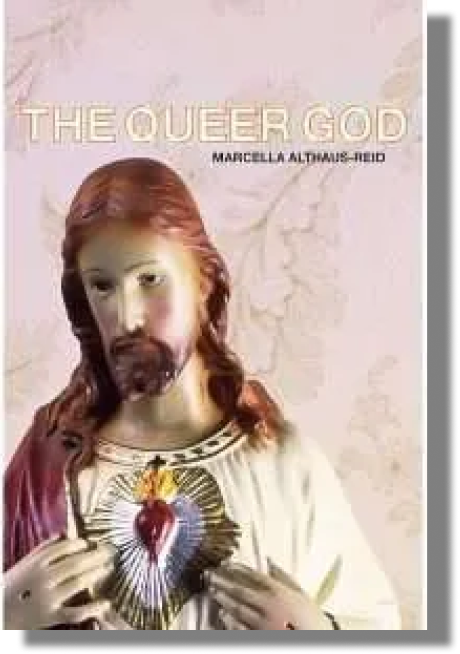
In her 2003 book The Queer God, leading queer theologian Marcella Althaus-Reid argued that the Trinity should be "understood as an orgy" and that "the Queer theologian can be seen as putting her hands under the skirt of God."12 Althaus-Reid embraced what she called a "libertine hermeneutic" drawn from the writings of the Marquis de Sade, from whose works the term "sadism" was derived. Althaus-Reid explicitly contrasted affirming theology with queer theology:
Queer Theology is a broader category whose permanent intent is instability.
Other queer theologians have offered similarly "subversive" interpretations of Scripture. As Cheng has summarized, Theodore Jennings "has suggested that YHWH, the God of the Hebrew Bible, can be understood as being the 'top' in a homoerotic relationship with David, the king of Israel." Roland Boer, Cheng noted, "argues that YHWH engages in a sadomasochistic relationship with humans… Boer superimposes the leather culture of BDSM on God."14
Why We Support Affirming Theology, Not Queer Theology
These examples help illustrate why queer theologian Laurel Schneider has conceded that queer theology "may spell disaster for gays and lesbians who just want to be included at church."15 To be clear: queer theology is not a synonym for affirming theology — nor should it be seen as a logical next step for affirming Christians who want to deepen their support for gay, bisexual, and transgender people.
Because queer theology adopts the categorically anti-normative posture and methodology of queer theory, it represents a radical rupture from the affirming position that the vast majority of affirming Christians hold.
Affirming theology and queer theology are fundamentally different because they are based on fundamentally different logical premises. Over time, the differences become increasingly evident and the paths only diverge more and more.
We are passionate about making the case in favor of affirming theology. We believe that the church should bless same-sex marriages and that gay, bisexual, and transgender people should be fully included in the church as equal members of the body of Christ.
Our position is distinct from queer theology for a simple reason: it is not based on the tenets of queer theory. Instead, our beliefs are grounded in our commitment to the authority of the Bible and orthodox Christian theology. We believe that Scripture does not condemn monogamous, covenantal same-sex relationships and that same-sex marriages can and do fulfill the core principles of Scripture's teachings about marriage: that it is a self-giving, covenantal union designed to reflect God's covenantal love for us in Christ.
We encourage affirming Christians to understand the distinction between our affirming approach and queer theology. The differences are significant, and it is important to be able to recognize and articulate them.