The critical reason why the church should not affirm same-sex relationships is because they violate divinely-ordained gender complementarity.
"Gender complementarity" is a broad category, not a universally normative biblical teaching.
Genesis 1–2
The critical reason why the church should not affirm same-sex relationships is because they violate divinely-ordained gender complementarity.
"Gender complementarity" is a broad category, not a universally normative biblical teaching.
Genesis 1–2
"Gender complementarity" is a category, rather than an argument in its own right. It simply asserts that there is a normative pattern of similarity and difference between the genders, but it doesn't state what that normative pattern is. When you press for more detail, you discover two critical realities:
People who may agree on "gender complementarity" as a general concept don't agree on what they mean by the term.
Attempts to support a more detailed or specific understanding of gender complementarity within the Bible and the Christian tradition fall short.
So what exactly are these different interpretations of gender complementarity?
Complementarians believe that men should lead and women should follow. We do see certain patriarchal norms reflected in Scripture, but the New Testament casts a vision of God's kingdom in which the hierarchy between men and women is overcome in Christ (Galatians 3:28).
The Bible never teaches that sex must be open to procreation in order to be moral. Moreover, in both the Old and the New Testaments, infertile marriages are not considered illegitimate. The marriages of Abraham and Sarah (Genesis 18) as well as Elkanah and Hannah (1 Samuel 1) were valid even in the long years before they had children.
The Roman Catholic Church — the main proponent of this view — has changed its position from "intending to procreate" to "openness to procreation." This suggests that even most Catholics don't see a problem with marrying a heterosexual couple who know they are sterile. But this allowance creates an inconsistency with respect to same-sex couples.
This view ends up being a "default position" when agreement on the other two is hard to reach.
But there simply are no texts in Scripture that address the most common way that anatomical complementarity is defined: the "fittedness" of male and female sexual organs.
Watch this lecture by Dr. Jim Brownson about the Bible and gender complementarity.
In his book The Bible and Homosexual Practice, Robert Gagnon argues that the original Adam of Genesis 1:26–2:18 is a binary or sexually undifferentiated being that is divided into male and female in Genesis 2:21. But as Jim Brownson has shown in Bible, Gender, Sexuality, this is not correct: Adam was originally male. The "myth of incompleteness" has no biblical basis.
The claim that male and female are both needed to unite in marriage in order fully to reflect the divine image (Genesis 1:27) is contradicted by Jesus himself, who is the image of God par excellence quite apart from being married. Gender complementarity is thus not part of the divine image, even though both male and female are equally in the image of God.
The focus in Genesis 2 is not on the complementarity of male and female, but rather on the similarity of male and female, over against the created animals.
The language of a "one flesh" union spoken of in Genesis 2:24 refers not to physical complementarity, but to the formation of a new primary kinship bond.
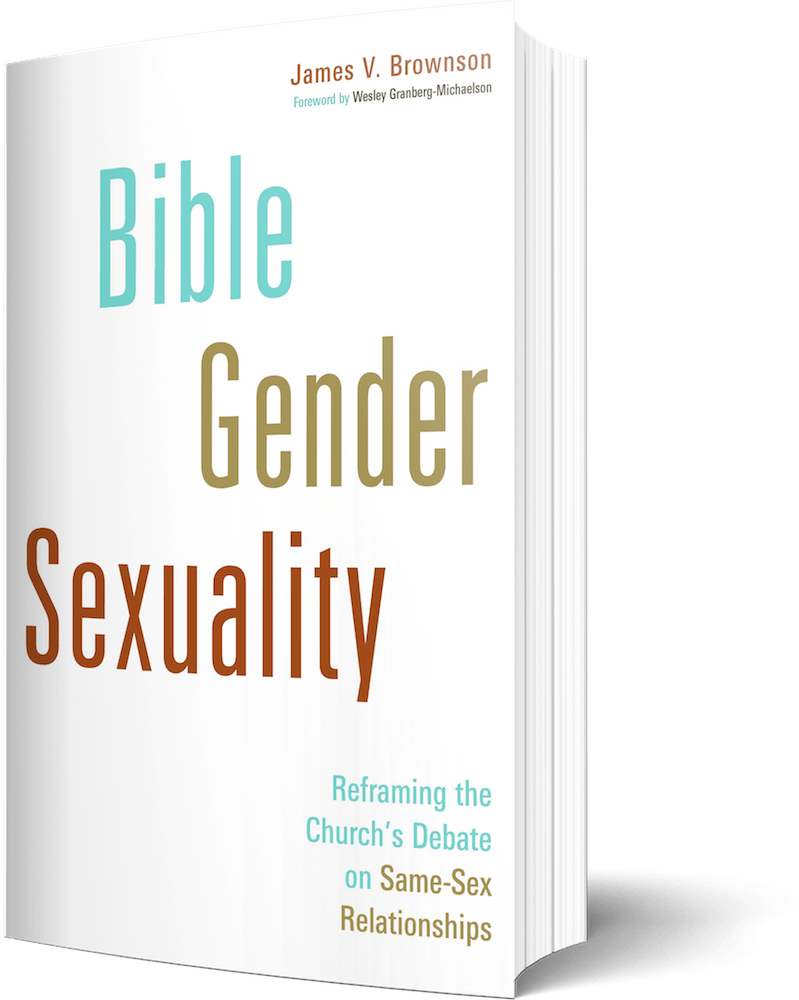
The most thorough scholarly examination of gender complementarity and the biblical texts on same-sex relationships. Brownson argues that no particular form of gender complementarity is taught as universally and exclusively normative in Scripture. Available wherever books are sold.
Find the book →In Scripture, Ethics, and the Possibility of Same-Sex Relationships, biblical scholar Karen Keen argues that Jesus appealed to Genesis to highlight an earlier precedent than the Mosaic law, which allowed a man to divorce his wife if she became "displeasing to him" (see Deuteronomy 24:1–5).
By citing "at the beginning" and linking it to "male and female," Jesus emphasized that God originally created human beings as a pair. His focus was not on sex difference, but — as Keen writes — on "the unity of two people" that should not be ruptured through divorce.
Jesus's emphasis on the union of only two is further supported by his statement that "the two will become one flesh." This phrase stands out because the Hebrew text of Genesis 2:24 says only "they become one flesh." The Greek translation of the Old Testament added the word "two," and Jesus may have quoted that version intentionally to underscore the principle of monogamy.
The eighteenth-century English theologian John Gill argued that Jesus's words were intended to exclude the possibility of "male and females" by highlighting that "Adam could not marry more wives than one." Similarly, John Wesley commented: "By making them one man and one woman, he condemned polygamy: by making them one flesh, he condemned divorce."
Jesus's appeal to "male and female" from Genesis stressed that marriage was originally a union of only two people. While that alone does not resolve the question of same-sex marriage today, neither does it rule it out.
What exact aspect of "gender complementarity" is violated by same-sex intimate relationships?
Where do you find this particular aspect of gender complementarity taught in Scripture as universally and exclusively normative?
When you engage in conversations about "gender complementarity," it's critical to push for a more explicit definition of what that concept means. It's precisely the generality of the phrase that allows entrenched assumptions — which may be widely divergent from each other, and which may have weak grounding in Scripture — to remain unexamined.
"Gender complementarity" is not a single biblical teaching — it is a collection of assumptions that, when examined individually, do not hold up to scriptural scrutiny.